Blog

2007 – Chicago – Rahnee Patrick

I was there, atop the 16th floor in the State of Illinois Building on September 11, 2007.

[youtube https://www.youtube.com/watch?v=5ZePF7th14Y&w=720&h=405]
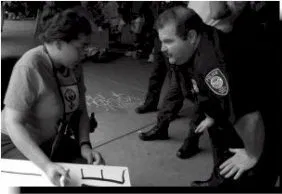
A woman with curly hair, glasses, and a dark top speaks into a microphone.
Rahnee Patrick

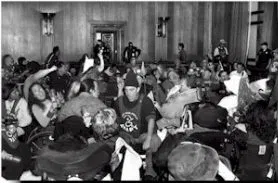
I was there, atop the 16th floor in the State of Illinois Building on September 11, 2007. Chants from our fellow warriors echoed far below, egging us on, declaring: “Our homes, not nursing homes!” We could see the colorful banners and protest signs unfurled throughout the marble-tiled lobby. ADAPT was in the house! The faces of Illinois’ Governor Blagojevich, Senate President Emil Jones, and Michael Madigan were mere puppets in our hands. Diane Coleman, Monica Heffner, Gail Kear and I had snuck past Illinois State Police. We looked down on the organized melee below, yearning to be downstairs amongst the rest of the crew.

Yesterday’s hit at the American Medical Association (AMA) kicked off the Fall Action 2007. We had last made a house-call to the AMA’s national headquarters in May 1992 at the same Grand Avenue location in Chicago, to demand its support of the then-MiCASA. They did not support MiCASA 15 years ago. Now, we were back, on a mission from ADAPT!

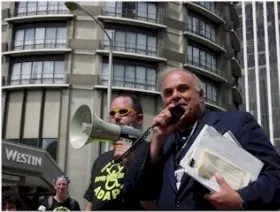
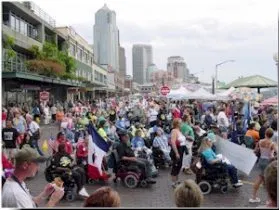
As we snaked through the crowded city streets of Chicago’s financial and theatre districts, we held up limousines, buses and sidewalks packed with tourists and business people. The morning news gave commuters updates on our progress. The Chicago Police Department grilled us on our destination as we twisted through the City. Our route took us past the fated State of Illinois Building. The cops, standing on their Segways, stood at the curb cuts, prepared to block us from going into the building. Little did they know, we had an appointment with the AMA. Doctors sign off on the paperwork that puts our folks into the nursing, intermediate care and state-operated facilities. We wanted them to support the Community Choice Act (CCA) and sign folks with disabilities into community settings.

As we approached the AMA, it became apparent that the cops had found us out. They had blocked the curb cuts with their Segways. The police surveillance truck in front of us stopped short of the next curb cut. Cassie James and I leaned our heads past its back bumper and gave a “What gives?” gesture to the head cop, high on a Segway. He nodded his head and the truck started moving forward. It cleared the curb cut. We followed and we broke onto the sidewalk. We buzzed for the accessible entrance. Despite street barricades at the doors, secured by sand bags, we had the building hermetically sealed within seconds. No one was getting out, except for emergencies or to negotiate with ADAPT.

Finally, an AMA representative came out to negotiate with us. We sent him back into his glass building, without their support for the Community Choice Act. If we could have seen into the future, we would have known, two months later, on November 13, the AMA would meet our demand and sign on as supporters of the CCA!

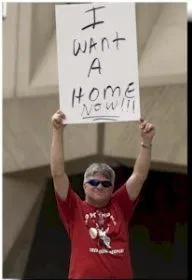
A man with short hair, sunglasses, and a dark top looks up and away from the camera.  A blue and white vehicle is in the background.

However, gaining entrance to the State of Illinois Building and its 16th Floor proved difficult but we had a plan. Earlier that morning, several covert ADAPTers strolled in the first floor and basement shops without wearing any ADAPT gear. I myself wore a pin striped suit while long-time ADAPT activist Diane sat pretty in a long, flowing skirt. Monica and Gail looked non-threatening in their casual wear. The Illinois State Police had check-points at the elevators in the lobby and basement levels. The four of us text-messaged each other about when to move while outside, the larger group crawled toward us like a giant tidal wave. One by one, we women approached the officers and showed them our ID’s. First, Diane and Gail went up, telling the cop they were headed to a floor other than 16. I was permitted to enter an elevator and held it as Monica rolled on. We rode uninterrupted to the 16th floor.

We heard the rest of the group splash in, the bullhorns and chants echoing. First, the downstairs group held the escalators and elevators on the lobby and basement levels. Thanks to an inexperienced security guard, we got to the glass doors of the Governor and Senate President’s office.

Negotiations stalled. The downstairs group sealed the building’s doors closed. No change on our floor. At 4:30 PM, when government officials usually leave, ADAPTers blocked the entrance to the elevated trains. Then, the Governor’s office agreed to our demands. In a public statement, in front of our activists, the State of Illinois committed to not re-open Lincoln Developmental Center as a developmental center, ADAPT would be at the table for the Money Follows the Person process and Governor Blagojevich would meet with the local ADAPT chapter before October 17.

On Wednesday, September 12, we flooded the headquarters of American Federation State County and Municipal Employees (AFSCME.) We want this union to support the Community Choice Act. Despite meeting with their representatives, they refused to support the choice for people with disabilities to live in the community. 120 ADAPTers committed civil disobedience, in protest of AFSCME’s decision. The people, united, will never be defeated!

This action was my first without the presence of Stephanie Thomas and Bob Kafka, as Bob had pneumonia. We all felt the hole of their absence. But we did not mourn, we organized! Every ADAPTer worked together even harder, to make collective decisions, to lead equally, and to pick up any slack. Fall Action 2007 demonstrated ADAPT would carry on with new leaders, even when our most revered ones are not able to be with us.

ADAPT Community Olmstead Implementation Plan

The ADAPT Community
OLMSTEAD IMPLEMENTATION

  1. Involve all groups concerned about developing more community services and avoiding unnecessary institutionalization. (IL, DD, Mental Health, Aging, etc.).
  2. Get data/information on number of people receiving community services, institutional services and waiting lists for each program. Research all funding (Title XIX Medicaid , Title XX Block grant, Voc Rehab, State etc).
    • Nursing Facilities
    • ICF-MR’s – large and small – public and private
    • State Hospitals
    • Waivers – number? How large? Who does it serve?
    • Personal Care Option – Who does it serve? Hours per week.
    • Home Health
    • State funded programs
  3. Outline of a Comprehensive Effectively Working Plan
    • What exists today. Programs, number of people served, waiting lists.
    • Development of identification process – using community organizations.
    • Development of support services (infrastructure) needed to get/keep people out of nursing facilities, ICF-MR’s and other institutions.
    • Intensive Service Coordinator
    • Simple Intake System
    • Waiver and other program development enhancements
    • Number of people per year that will transition out of nursing facilities, ICF-MR’s and other institutions
    • Number of people per year that will be diverted from nursing facilities, ICF-MR’s and other institutions
    • Identification of and recommendations for the elimination of barriers to community placements
    • Regulations (Nurse Practice Acts, licensing, etc.)
    • Affordable, accessible, integrated housing
    • Transportation
    • Quality monitoring system based on consumer satisfaction
    • Per year funding for implementation of plan

DIA – Disability Integration Act

What is the Disability Integration Act?

The Disability Integration Act (DIA) is a civil rights, bipartisan and bicameral legislation, introduced by Senators Charles Schumer, Minority Leader (D-NY) and Cory Gardner (R-CO) in the Senate and Representative Jim Sensenbrenner (R-WI) in the House, to address the fundamental issue that people who need Long Term Services and Supports (LTSS) are forced into institutions and losing their basic civil rights. The legislation (S.117, H.R.555) builds on the 25 years of work that ADAPT has done to end the institutional bias and provide seniors and people with disabilities home and community-based services (HCBS) as an alternative to institutionalization. It is the next step in our national advocacy after securing the Community First Choice (CFC) option.

CALL TO ACTION: Help David get out of this death pit as he desperately wants and needs!!

For Immediate Release


For information contact North Central PA ADAPT:
Shaylin Sluzalis – ssluzalis@gmail.org – (570) 777-0268


CALL TO ACTION: Help David get out of this death pit as he desperately wantsand needs!!


Confiscation of Resident’s Property, Inappropriate Admission to Local
Nursing Facility Are Civil Rights Violations


David, a resident of Embassy of Loyalsock wants out! He also wants his rights restoredand his court appointed guardianship terminated.


During this pandemic, residents like David count for more than 70% of Pennsylvania’s COVID, and 40% of the National Covid deaths. David does not meet eligibility criteria fornursing facility admission, and his current admission therefore violates federal regulations, violates his civil rights, and constitutes a threat to David’s life during this pandemic.


• The court-appointed guardian is violating David’s rights as well as his civil liberties by ignoring his wishes to receive community-based services back in his own home, a much safer environment than any nursing facility.


February 5, 2021, Williamsport, PA


David notified us that Embassy of Loyalsock confiscated the cell phone provided to himby Roads to Freedom, a Center for Independent Living that is federally mandated to provide advocacy, institutional transition services and other disability related services such as Assistive Technology to assure people with disabilities have equal access to information and communication.


David is being forced to share a room, phone and bathroom with three other
people. Stripping him of his personal cell phone is not only a rights violation, it’s inhumane! David does not meet the eligibility criteria for nursing home admission, yet he has been locked in a dangerous, restrictive environment and deprived of the means to communicate with the outside world.


For more information or to contact North Central PA ADAPT:
Shaylin Sluzalis – ssluzalis@gmail.org – (570) 777-0268


David’s right to be treated with dignity and respect is being violated each and
every day.


David has told us, “Every day I wake up in here, I wonder if this is the day I get
COVID and is this the day I will die here.”


The court-appointed guardian has failed to include David in the development
of a plan of supportive services, and in discharge planning as federally mandated.


Duties of any guardian of a person in Pennsylvania include:


(1) assertion of the rights and interests of the incapacitated person;
(2) respect for the wishes and preferences of the incapacitated person to the greatest extent possible;
(3) participation, where appropriate, in the development of a plan of supportive services to meet the person’s needs; and
(4) encouragement of the incapacitated person to participate to the maximum extent of his or her abilities in all decisions that affect him or her, to act on his or her behalf when he or she is able to do so, and to develop or regain his or her capacity to manage his or her personal affairs to the maximum extent feasible.


David has not been afforded these rights.


Disability Rights of PA has written “…the court has the power to place total control of a person’s affairs in the hands of another. This great power creates the opportunity for great abuse.” We see this as what has indeed happened in David’s case, and this abuse/neglect has had a direct impact on David’s mental and social well-being.

Court-appointed Guardian, Mary Beth Swan, Hundington County Area Office of Aging, is guilty of a conflict of interest because she represents both a provider of services that should be meeting David’s needs, and the role of guardian who is bound to assure that David’s needs are being met. Acting as the Financial Manager of his Estate (his home he desperately wants to return to), the Ombudsman, the Adult Protective Service Provider and Guardian are not only grossly conflicting roles, but have given her the power to steal his phone and his life, with no one to represent David’s wishes and interests.

Call Mary Beth Swan,
Protective Service and Care Manager Supervisor
Huntingdon Office on Aging

For more information or to contact North Central PA ADAPT:
Shaylin Sluzalis – ssluzalis@gmail.org – (570) 777-0268
307 10th Street, Huntingdon, PA16652.
(814) 643-5115, (800) 528-9155
Fax No. (814) 643-4249
814-494-2327 Cell
mswan@hbfaaa.org


Tell her ADAPT demands:
• She order the Staff of Embassy of Loyalsock nursing facility to
return David’s phone that is locked in the facility’s safe!
• Notify the Judge of her multiple conflicting roles, and petition
the court for a hearing to restore David’s rights, including an
independent third-party assessment and David’s preferences.
###

2019 Fall October 20-23 Washington DC National Action

ADAPT is in DC fighting for it’s Vision of Community for ALL

Disability rights activists from ADAPT returned to D.C. this week to spread ADAPT’s vision of Community for ALL.

Follow us on this page and on Facebook and Twitter for updates throughout this week.

Action Reports

Pictures

Sunday September 24 2017

By Carol Tyson
Metro DC ADAPT

Person with a buzz cut, glasses and a red shirt peers off into the distance.
Carol, an ADAPT activist from Washington DC

Hi. My name is Carol. I live in Washington, DC. A very dear friend of mine (who was with us today) introduced me to ADAPT before I acquired my disability years ago. Knowing that the disability rights movement existed, and had my back, helped me to fight and to live through some dark times. I’ve attended ADAPT actions in the past, to support. Today was the first day I participated as a member. I am so grateful and proud. It is super-late as I write this, so please excuse any rambling. … These are the highlights from my day.

I arrived at the hotel in time to grab a coffee just before the issues meeting. The medium-sized room was packed. We learned about the history of ADAPT, how it was started in the early 80’s in Denver, CO, by a group of rowdy activists to get lifts on buses. The movement spread across the country and, after years of actions, ADAPT won. Hearing this story retold was a perfect way to start my day – access to transportation is an issue I am passionate about. We learned that after the passage of the ADA ADAPT switched its focus, and began to work on getting our community out of nursing homes because they couldn’t access public transit. ADAPT is now calling for the passage of the Disability Integration Act which would, among other things, establish living in the community as a civil right. The lack of affordable, accessible, integrated housing would no longer be an excuse to keep people on waiting lists. (Sounds great!) We also learned that the Graham-Cassidy ‘healthcare’ bill would not only repeal the Affordable Care Act (aka Obamacare), but also demolish the Medicaid program as we know it. (AAAHH!)

After the issues meeting we moved into a larger room – even more packed. We learned dos and don’ts for how to respond in an action. A diversity statement was read and we were all reminded that it is important to acknowledge differences and diversity, to support ADAPT members of color, LGBTQ+ and gender nonconforming members, to call each other out if needed, and to keep an eye out for each other, and be aware if anyone is being targeted. I was grateful to hear this as a priority of the group. We were reminded that while we are all participating because issues are important to us individually, we are also here representing and speaking out for our disability family who can’t be here this week.

Later (after a much need lunch and more water), we lined up and began our looooong march/roll in the unrelenting sun and heat to — ummm, I didn’t know where we were headed. We walked/rolled past houses and hotels, tourists and DC residents, chanting: ‘Our Homes, Not Nursing Homes! ‘Disability Integration is a Civil Right!’ and ‘Down with Nursing Homes! ‘Up with Attendant Care!’ Many people took flyers about ADAPT, some cheered us on. Eventually, we turned down a side path, and squeezed ourselves onto a narrow sidewalk leading to some pretty nice looking apartments that faced each other. Then, we were told we were at Attorney General Jeff Sessions’ home and we chanted even louder, so he would know we were outside. A press release explaining why we were there was read aloud – including asking the AG to do his job, and for the DOJ to enforce the ADA and the Olmstead Supreme Court decision. The action felt great, and was a huge success.

We squeezed ourselves back out, and returned to our marching line – chanting again – eventually making it back for a debrief. We heard from seasoned ADAPT members and those who were brand new; we sang, and expressed our excitement for the days of action to come. I met old and new friends – some who I’ve only know on Twitter. I got a little teary eyed (nothing new), but they were happy tears, fierce, ‘hey – we got some demands and we’re gonna be heard, and we deserve to exist’ tears. I’m looking forward to tomorrow. To anyone reading this, I’ll be thinking of you.

By Cal Montgomery
Chicago ADAPT

Person in a power wheelchair, buzz cut, and red tee shirt looking at a cell phone.
Cal Montgomery

After a series of training meetings all morning, we headed out to lunch and then lined up in our teams — I was on the red team. It was hot. They handed out bottled water in line.

We headed down C in single file, turned left on 2, and filed down to Attorney General Jeff Sessions’s home, where we met up with other teams. Using a portable ramp to get over a barrier, we crowded in as close as we could to our target and began to chant. I’m told two neighbors came out — one to say he wished he had a bigger dog and one to offer protesters water and chant with us. Another activist who was up front said that although Sessions wasn’t home, someone kept opening and closing the shades.

A couple of security guards showed up, listened for a moment and moved through the crowd and away. Apparently our sound system went down, so as Mike Oxford read out our demands from the back near me over an old-school loudspeaker, someone further up shouted them to the front. Sessions claimed during his confirmation that the U.S. “government is one of laws, not of men.” He promised “to see that the laws are enforced faithfully, effectively, and impartially.”

But the laws protecting our right not to be unjustly imprisoned are not enforced. We are forced into institutions. Many of us die there. Our Lives and Liberty, promised to us in the Declaration of Independence, are routinely denied. Today, ADAPT insisted that Sessions admit that forcing us into institutions violates our Constitutional right to Liberty.

We insisted he work with the disability rights community, including ADAPT, to enforce the Olmstead rights of people in nursing homes nationwide. We insisted he work with the autistic community and ADAPT to change the conditions of institutionalized people at one institution, the Judge Rotenberg Center by stopping one of the aversive procedures they use in the process of applied behavior analysis.

And in light of the deplorable conditions faced by disabled people after recent disasters, we demanded he work with NCIL and ADAPT to ensure our civil rights and liberties are protected when disaster strikes. When the group was confident that we had been heard, we marched back to the hotel to meet up with the activists who attended the second action and go to a big meeting to debrief and prepare for tomorrow.

By Kimberley Jackson
Denver ADAPT

Person in a power wheelchair with a cap and mask, dark shirt and shorts.
Kimberly Jackson

We started to line up around 1:30 in the afternoon by color group. As this is my first national action, it was a little daunting to get in a line with hundreds of other advocates, many in power wheelchairs like myself, and follow the leader without knowing exactly where you are headed or how long it will take. Add in the 90 degree heat and humidity, and it took an act of faith to keep going.

Eventually the red team split from purple and orange, and we were lead over a cobble stone driveway that was a roller coaster of ups and downs. We finally arrived at courtyard outside of three houses. After everyone was packed in, it was announced that we were at the house of Jeff Sessions, the US Attorney General. As we were told by the ADAPT leaders, the Department of Justice hasn’t done anything to enforce the ADA or the Olmsted Act under the current administration.

While we were there, it was reported that one of Mr. Sessions’ neighbor came out to talk with us. When someone gave the example of an older woman being forced to go into a nursing home because of needing some help at home, he responded that that was how it should be. One of his neighbors came out, and started arguing with him about how ADAPT was right. Mr Sessions either didn’t come out or wasn’t home, but we promised him we’d be back.

We mostly rode back the way we had came, rolling and walking in the street to avoid problems with sidewalks and curb cuts. We were all dragging from the heat, and more than a few people had to pull to the side to cool off. I think everyone was happy to be back in the hotel air conditioning at the end of the day. All in all, it was a great start to the action.

By Liam Dougherty
Philadelphia ADAPT

A person in a power wheelchair wearing an ADAPT tee shirt and dark pants.
Liam Dougherty

It was Adapt’s first day in Washington DC. I woke up around 7am, got an Egg McMuffin, and went to the Issues Update meeting in the conference room at the Holiday Inn. Bruce Darling and Mike Oxford talked about Adapt’s mission, in the past and present. Its current priority is getting government to provide affordable, accessible, integrated housing, instead of the isolation of life in a nursing home. We also talked about the Disability Integration Act, legislation that was made by Adapt, crafted to end the “institutional bias” and grant fundamental civil rights to people with disabilities.

Then we had a full meeting, with all 200 Adapters. It was amazing to see so many of us, with all kinds of disabilities and assistive equipment. We discussed some rules of our actions, such as always traveling in an unbroken single-file line. Then I went over to the Media meeting (#adaptandresist) and lined up with the rest of the Blue team to go.

We marched for about an hour, through 90-degree weather, chanting and playing noisemakers and tambourines. Day-leaders brought a small ramp, which we used to jump the curb to get to Attorney General Jeff Session’s home. We chanted and shouted, saying he is not doing his job in protecting the civil rights of our people. One of his neighbors came out and yelled at us, saying we had no right to go to somebody’s home and harass them. We responded that it is the only way to get his attention, and that it must be nice to have a home in the first place, and not to be forced into a nursing home.

We marched back and had a big recap meeting. Now I am sitting in the hotel lobby, tired and still sweaty. We are all bracing for the next day of the action.

2019 Spring Action – Day 1

By Anja Herrman
Chicago ADAPT

Hello! On day one of the daily summaries log, today adapt participated in the adapt fun run for disability rights 2019. The run was held as a fundraiser for a gap in our spring 2019 national action. The activist were eager to move to show their support for disability rights.

By Beatrice
Boston ADAPT

Today on May 19th 2019 the National ADAPT Association held it’s 14th annual Fun Run for Disability Rights in Washington D. C. at the upper “D” Park and it was fantastic. We had 154 people show up today to walk and roll around the park to raise funds for the different chapters of ADAPT which work hard to fight for the rights of all disabled individuals across the world. People enjoyed the 80+ degree heat while walking and rolling around the park and enjoying listening to the music.

By Liam Dougherty
Philadelphia ADAPT

Today we had our first meeting at 8am. We discussed general advocacy issues, with specific attention to the Disability Integration Act, legislation that would make community integration a human right for people with disabilities. Bruce Darling led the discussion, saying “some people say lawmakers should hear your footsteps if you want to influence policy- I say let them hear your squeaky wheels”. Next media team met to give out roles and assign hashtags for the action. We lined up around noon and marched to Upper D Park – Area 14 – “C” St. SW and South Capitol St., where we did our Fun Run fundraiser. It was very hot and sunny but a lot of fun. We made sure to stay hydrated. We then came back for an energetic and rousing group meeting. I am excited for this week with ADAPT.

2019 Fall Action – Day 3

By Jordan Sibayan
Atlantis ADAPT

Picture of a person in a power wheelchair holding a red and black bag.
Jordan Sibayan

All Are One…
That was the theme for our day.

In the grand scheme of the world, every aspect of our lives are intertwined…where we are from…our personal histories… the color of our skin…the language we speak…our disabilities. They intertwine in our interactions with others…locally..nationally…and globally. We must all remember this.

FEMA got a visit to ensure that we hold them accountable for displaced disabled Americans impacted by natural disasters. The latest devastating storms that have ravished the southern states have impacted and destroyed the homes and lives of countless families. In the mist a better effort is needed to ensure access and transport to shelters…access to Attendant care…and an adequate rehabilitation program emphasized in ensuring the continued integrated independent living after the storm passes.

Home is where a lot of things start. We hope that our home is our own salvation…our paradise…ours to design and dream. Many cannot find their own paradises since there is still a serious lack of housing that is accessible…affordable…and safe. Housing in real communities not tied to services or programs. At our stop at HUD we talked about the struggle to find housing that meets our housing platform requirements.

We took our March to the Navy Memorial…our veterans and decorated heroes that serve our country. They deserve to live in the land they fought to defend…in their own homes and communities. Some come back though and end up institutionalized because of disabilities they gained in combat. They deserve a life better than that. We were reminded that Disability Rights are Veterans Rights. I think often of my brother Justin…cousin Gavin and his wife Stephanie. They all served and I am so proud of their service. My cousin was injured in a roadside IED…and ended up diagnosed with a TBI as well as injuries to his legs. He plays soccer for the Special Olympics. He fought for his family to live in freedom…and so we give back as a group including many disabled vets. Recognizing their struggle and how it is connected..and one of many aspects of life.

As we continued we ended up at the sacred grounds…of which many DC belongs to lands that was taken and stolen from the indigenous peoples that lived before. We made our way to the National African American Museum of History and Culture. It was there we heard the names of many of our ADAPT members and allies whom we have lost along our long journey. They fought to have rights not only as disabled Americans…and as African Americans and people of color in America. We honor the sacrifice and the good work of our ancestors on the land and the memory of powerful people in our movement who have contributed to the movement and betterment of our country.

We found ourselves on the move again. Arriving at the DC office of the US Customs and Border Protection. They have been a part of horrible acts at the border to separate immigrants from their families. We heard stories of those seeking a better life in our countries…life sustaining and saving services…as well as fleeing countries that may not have access to home and community based services…either due to laws…lack of human rights or disability rights…or any number of reasons. Regardless…no one should be caged like an animal and no one should be locked up because their disabilities are too hard to handle. That is not how we should be treating any human being. This happens in our country at institutions. It is a human rights issue and the practice against disabled citizens of the world should be denounced.

We finally went to the house of the head of the administration. The White House. The Trump Administration has been known to make decisions that would impact many people and many aspects of our lives… including people with disabilities in America and across the globe. We called upon them to do better…do no harm…ensure our right to independence…community…and freedom. For us…all of us.

American has been looked on as a beacon to the world…the world is looking to us. Because all are one.