PA ADAPT Demands of Governor Wolf

On December 6, 2018, PA ADAPT went to Governor Tom Wolf’s office at the same time the Managed Services and Supports (MLTSS) Subcommittee meets because the managed care agencies and the Office on Long Term Living have not been working with the disability community, and have not been listening to our demands and concerns during the rollout, specifically the transition in the Southeast (who makes up 40% of manage care) to provide Real Choice.

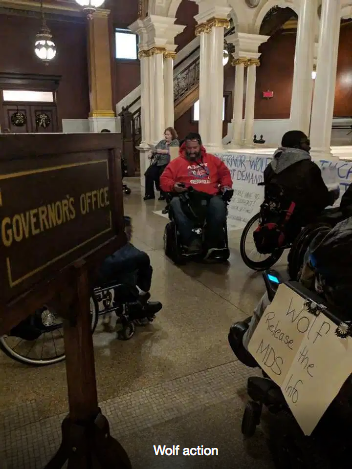
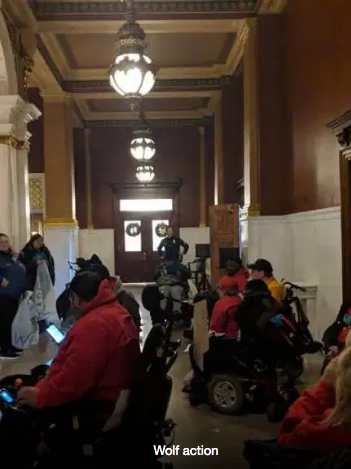
Conveniently, it was our Capitol’s annual Tree Lighting Ceremony and Governor Wolf was scheduled to make an appearance. After two elevators and a small diversion around the Christmas tree, by 10AM all 23 of us were in and outside of Wolf’s office for nearly two hours chanting: “Who do we want? Governor Wolf! When do we want him? Now!” with Capitol police surrounding (and “trying” to control) us.

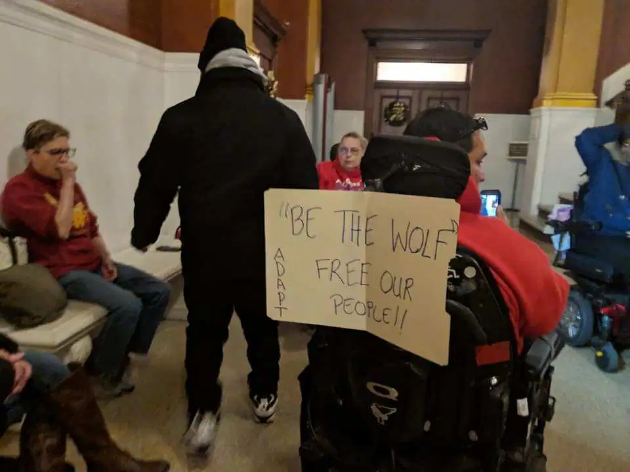
People are spread out in a hallway. Foreground: The back of a person in a power wheelchair with a sign saying "Be The Wolf Free Our People ADAPT"
Louis at Wolf action

“Who do we want? Governor Wolf! When do we want him? Now!”

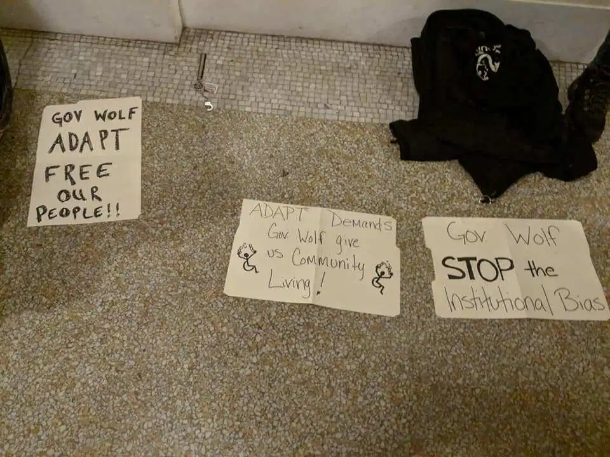
Three signs spread out on a floor. "Gov Wolf ADAPT Free Our People!!, "ADAPT Demands Gov Wolf give us Community Living", and "Gov Wolf STOP the Institutional Bias."
Signs/theatre at Gov. Wolf action

Before the choir was set to sing Governor Wolf came up to his office and hushed our chanting with his apologizes that managed care is not rolling out smoothly, and that it is his top priority to work with us to fix these problems for all Pennsylvanians receiving long term services and supports. He promised to have next steps specific to our demands sent to us by Tuesday, December 11th.

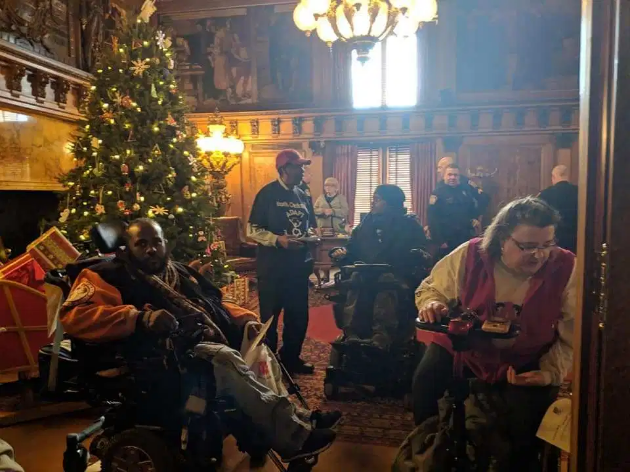
A group of people, some in wheelchairs and some standing in a room with a decorated Christmas tree.
Inside Gov. Wolf’s office

After we met with the Governor, we marched from the State Capitol over to the Department of Education building – just in time for the public comment section of the MLTSS Subcommittee agenda. Since we had just protested this meeting on November 7th demanding they extend the enrollment period for the Southeast, they were not unfamiliar with our demands. Zack Lewis from Philly ADAPT reminded the managed care organizations and the Office of Long Term Living that, “We will not accept the MCOs & OLTL lack of response to our demands, and to prove it – we just got in from the Governors office who is in full support of our demands and has promised to hold everyone in this room accountable for what’s happening to the disability community in Pennsylvania.”

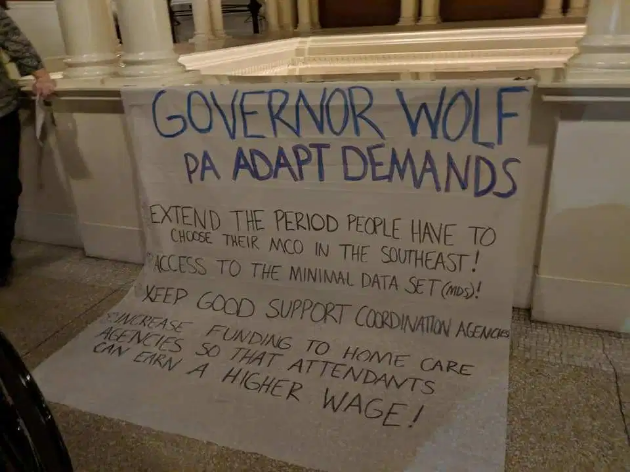
PA ADAPT DEMANDS OF GOVERNOR WOLF:

  • EXTEND THE PERIOD IN WHICH PEOPLE HAVE TO CHOOSE THEIR MCO IN THE SOUTHEAST!
  • ACCESS TO THE MINIMAL DATA SET (MDS)!
  • KEEP GOOD SUPPORT COORDINATION AGENCIES!
  • DRAMATICALLY INCREASE FUNDING TO HOME CARE AGENCIES SO THAT ATTENDANTS CAN EARN A HIGHER WAGE!
A sign "Governor Wolf PA ADAPT Demands
Extend the period people have to choose their MCO in the Southeast!
Access to the minimal data sets (MCO)!
Keep good support coordination agencies!
Dramatically increase funding to home care agencies so that attendants can earn a higher wage!"
Demands of Gov. Wolf

PA ADAPT has not heard a response from Governor Wolf’s office as of Monday, December 10, 2018 but we are eager to hear from him as he promised.

ADAPT’s open letter to FEMA administrator Brock Long

Federal Emergency Management Agency
Administrator Brock Long

Dear Administrator Long:

When disaster strikes, people with disabilities are disproportionately affected. It is the stated mission of FEMA “to reduce the loss of life and property and protect our institutions from all hazards by leading and supporting the nation in a comprehensive, risk-based emergency management program of mitigation, preparedness, response, and recovery.” With respect to people with disabilities, FEMA is failing to lead, failing to provide support, and failing to protect lives.

It was gravely disappointing to see FEMA release a strategic plan that does not include preparedness, planning or response elements specifically addressing people with disabilities. The consequences for this lack of planning means that, following disasters, people with disabilities often face choices such as: death or placement in an institution.

FEMA’s strategic plan should include input from, and reflect the experiences of people who have lived through natural disasters, who have perspective on service delivery gaps following disasters, and who have ideas and initiatives for addressing such gaps.

We are demanding that FEMA go back to the drawing board for their strategic plan. Recognize that the current plan’s oversight by not including people with disabilities is not something that can be fixed by holding “after the fact” meetings. Re-start the planning process by including people with disabilities in the formulation of the plan.

We are respectfully requesting the following:

  • Cancel the meeting scheduled for November 8, 2018, and notify attending parties of the same.
  • Re-convene the strategic planning process, starting with national input/listening sessions, to ensure the experiences and input of people with disabilities who have faced a variety of types of disasters are incorporated into the planning process.
  • Include disability advocates, providers, and service and support systems from other areas of the government in the drafting of a strategic plan, to ensure that agencies in other areas of government are not, for example, expediting the needless institutionalization of people with disabilities, rather than coordinating their systems with FEMA efforts and plans.
  • Bring in non-governmental partners so they have a clear understanding of the expectations related to their role supporting FEMA’s strategic plan, especially as it relates to people with disabilities.

ADAPT Demands FEMA cancel the Strategic Planning Meeting until after the above demands are met. We Demand REAL disability stakeholder input in the planning, implementation, and execution of services for people with disabilities. We Demand Our seat at the table – Nothing About Us, Without Us!
Confirmation of the meeting cancellation and next steps towards the meaningful inclusion of people with disabilities in their disaster planning and relief can be sent to Philadelphia ADAPT organizer, Germán Parodi at germanparodi@msn.com.

In justice and equality,
Regional ADAPT Organizers

North Central PA ADAPT demands Congress Marino to support DIA

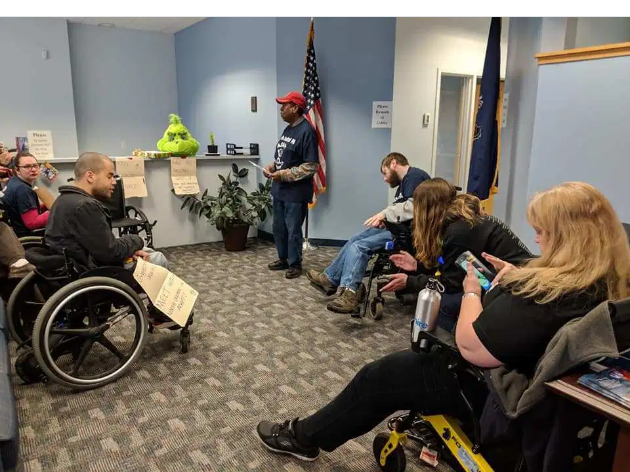
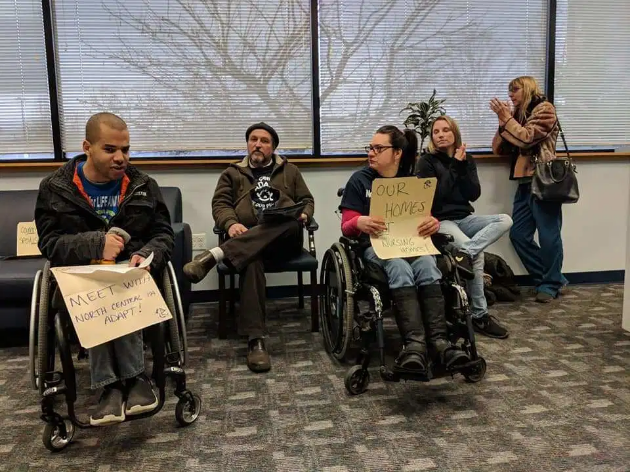
On December 14, 2018 North Central PA ADAPT went – yet again – to Congressman Tom Marino’s office in Williamsport PA.

For over a year NCPA ADAPT has tried to meet with Congressman Marino to secure his support for disabled and elderly Americans to live in freedom in the community. Not only has the Congressman avoided us at scheduled appointments with him, but has also broke his promises to us as a group and to individuals in our group about sitting down and meeting with him.

Every now and then his DC staff will pretend to work with us and “promise to get us the Congressman’s response” to our demands, but at every turn his staff stop responding and continue to ignore us.

On Friday, December 14th we decided enough is enough! It’s time for Congressman Marino to know that NCPA ADAPT Demands his support!
Disabled constituents are just as much constituents as anyone else and it’s time for him to work with us!

Since his staff in the Williamsport office were not willing to at least get Marino on the phone, 10 NCPA ADAPT Activist sat inside his office chanting:

“Who do we want? Marino! When do we want him? Now!”

“Marino, Marino come on out – ADAPT has something to talk about!”

while two of our other ADAPTers handed out flyers to people coming out of Planet Fitness and informed the public why we were “disrupting” their workout. Nearly every passerby was in support of our demands.

After two hours of chanting Congressman Marino had the Williamsport Police show up to tell us we were “trespassing.” It was only noon and the office was clearly open, since it’s a public entity, he is Our Congressman, and we weren’t going anywhere – we called the cops bluff. We stayed chanting for another half hour while the cops stood outside tapping their hands to the beat of our chanting.

Congressman Marino is well aware that we were in his office, and who knows, maybe he was hiding in the back like he has in the past. We decided to save of our ADAPT Power for future follow up, so before heading out for the day we made sure his staffers heard that all he has to do is respond to us – otherwise ADAPT will be back.

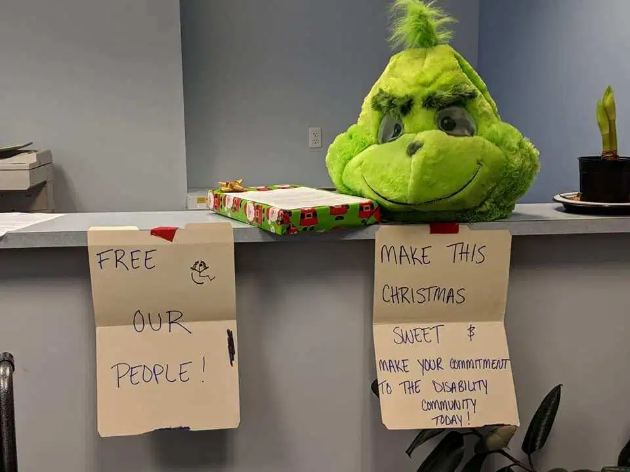
We let it known that all we want this Holiday Season is for our Congressman to stop being a Grinch, and give the gift of SHOWING his support for our right to live in the community and not in institutions.

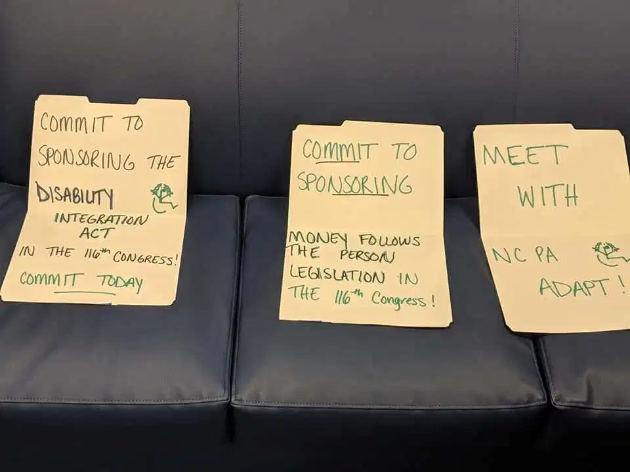
North Central PA ADAPT Demands:

Congressman Marino show us his support by:

  • Committing to sponsor Money Follows the Person legislation in the 116th Congress
  • Committing to sponsor the Disability Integration Act in the 116th Congress
  • Meet with North Central PA ADAPT!

Activist for disabilities rights bring ‘people power’ to the Texas Capitol

ADAPT of Texas pushes for better pay for community attendants who help Texans with disabilities have an independent life.

When Bob Kafka paid the barista for his afternoon caffeine boost at a popular coffee shop in the shadow of the Texas Capitol, he was literally handing money to his competition.

Kafka, a quadriplegic who has used a wheelchair to get around since being injured in a car wreck 46 years ago, is one of the leading advocates for the rights of people with disabilities in Texas. He’s pushed for better access to public facilities, alternatives to life nursing homes for people who can live independently and for reliable public transportation for people with limited mobility.

ADAPT organizer Bob Kafka is one of the leading advocates for the rights of people with disabilities in Texas.

And as action picks up in the 2019 legislative session, Kafka’s mission is to persuade lawmakers to raise the Medicaid-subsidized pay for what he calls community attendants who provide basic care for an estimated 200,000 Texans with disabilities who might otherwise be institutionalized.

‘We have a literal crisis’. “Right now the base wage for most (attendants) is $8 an hour,” Kafka said in an interview. “No health insurance, no vacation, no sick leave. You can go almost anywhere in Austin, Brownsville, Amarillo, Tyler, and they’re paying $10-12 an hour for fast food.

“We have a literal crisis. We have a shortage of people who want to do this kind of work. They can make more at Starbucks.”

He’s pushing to increase the pay to $15 an hour. It’ll cost the state more than $1 billion. But if people with disabilities cannot cannot get attendants who make independent living possible, they’d be forced into nursing homes that would cost taxpayers more money in the long run, Kafka said.

For more than two decades, Kafka has been a fixture at the Texas Capitol. When the Legislature is in session, he leads a cadre of volunteers, most of them in wheelchairs, who pay visits to lawmakers’ offices, educate legislative staff members and hand out a seemingly never-ending supply one-page fact sheets to House members and senators as the enter their respective chambers.

What they do appears to be intense lobbying. But it would be a mistake to call them lobbyists. They aren’t paid for their advocacy and, unlike paid lobbyists at the Capitol, they have zero money to spend on meals and drinks for politicians to call attention to their cause.

During a recent visit to the Capitol, Kafka and five volunteers from the disabilities-rights group called ADAPT of Texas assembled outside the hearing room where the budget-writing House Appropriations Committee meets. A lawmaker called out to them with a “how you doing?” as he prepared to go through a private back-room entrance.

“Tell them we need $15 an hour for community attendants,” Kafka replied without missing a beat.

Kafka, a New York native who’s 72 and still speaks with a thick Bronx accent despite having lived in Texas nearly half his life, knows he’s in an uphill fight this year. Although lawmakers are not facing a cash shortfall, state leaders have made clear that this session their priority is to boost spend for public schools.

But he also knows that persistence pays off. When he first came to the Capitol, about 80 percent of people with physical and mental disabilities receiving government assistance were in nursing homes. The ratio is about 50-50 now, Kafka said.

Former state Rep. Velma Luna, a Democrat who represented Corpus Christi in the Texas House from 1993 until 2006, said Kafka and the ADAPT volunteer have put a human face on people who a generation or two ago were sometimes referred to as shut-ins.

“They’ve really raised awareness, especially for people whose live might not have been touched by someone who’s disabled, someone in a wheelchair,” said Luna, who in her final terms in Austin was vice chairwoman of the Appropriations Committee. “They have humanized an entire community.

Cathy Cranston, an ADAPT organizer whose husband Ron is among the volunteer advocates, said the need for home attendants is vital. For some clients, attendants might be the only people they interact with regularly.

“They provide basic human contact for so many people who are hungry for human contact,” Cranston said. “That is so important.”

The attendants provide much more than that, Kafka added, acknowledging the demanding nature of the work done by community attendants.

“If you need somebody to help you get in and out of bed, shower, toileting, whatever, it’s a seven-day-a-week need,” he said, noting the high rates of burnout and turnover.

“I can tell when one of our people are having trouble finding attendants,” he added. “Besides their mental approach, they physically look different,” he said, adding clients are more prone to sickness and infection “because they had to sleep in their wheelchair.”

“We had one person tell us she had a home attendant for 20 minutes,” he said. “Just think of that.”

Jim Brocato, executive director of the Rise Center for Independent Living in Beaumont, said the work Kafka and his ADAPT volunteers do in Austin reverberates around the state.

“Bob Kafka is the guru of advocacy for independent living,” Brocato said. “He is knowledgeable and he’s prepared. He is modest but relentless. The work he’s done has kept people out of nursing homes who don’t need to be in nursing homes.”

Kafka is a Vietnam veteran who graduated from the University of Houston with a degree in economics. His attire, even when testifying at legislative hearings, is generally jeans, a T-shirt and a wide-brimmed hat with a flower in the band covering the top of shoulder-length graying curls.

He once boasted that he hasn’t owned a suit and tie since being discharged from the Army in 1967. His early advocacy, including activism to help pass the Americans with Disabilities Act during President George H.W. Bush’s administration, was sometimes confrontation and once led to him being arrested. His approach has mellowed since then.

“We’ve done over the years civil disobedience,” he said. “I can tell you, chain yourself one time to anything and that’s the only thing anyone will remember.”

He calls the approach to advocacy by him and the ADAPT volunteers “people power.”

“They’re well-trained and they know what they’re doing,” Kafka said. “Everyone of our people are volunteers They are people who are receiving services.

“We personalize it. So much of the stuff at the Capitol is devoid of people.”

https://www.caller.com/story/news/local/texas/state-bureau/2019/02/01/activists-people-disabilities-lobby-people-power/2699487002/
Philly ADAPT demands City Council accountable for AFFORDABLE ACCESSIBLE INTEGRATED HOUSING!

September 12, 2019

Philly ADAPT joined the rest of the Philadelphia Coalition for Affordable Communities (PCAC) for Philadelphia’s first day back at City Council after the summer recess. We all wore headbands with thought bubbles saying things like “When will I have an affordable place to live?” and “Who will stand with us this year?” Philly ADAPT works with PCAC in the fight for affordable, accessible, integrated housing. We demand more support from our council members, many of whom either ignore our voices or act contrary to the hopes of the disability community and in favor of rich developers building ultra-luxury condos. Our coalition filled the public meeting room, and our strength and presence were definitely felt by those in power.

We Will Be Back & hold our City Council accountable! AFFORDABLE ACCESSIBLE INTEGRATED HOUSING!

PA ADAPT Action – Institutions are not the solution – Action against SB 906

On Monday, November 18, 2019 PA ADAPT got together at the Capitol demanding our elected officials Not to take us back in history 45 years, and vote NO to SB 906.

SB 906 would not only keep the Polk and White Haven State Centers open after the announcement of their 3-year plan closures, it would also institute a moratorium on all closures of State funded intellectual disability and developmental disability centers and other long-term institutions.

Meaning, SB 906 would make it impossible to continue de-institutionalization in Pennsylvania as it would mandate no institutions will close until all people who qualify in PA (including our current growing waiting list of 13k) for Home and Community Based Services are enrolled.

We started our morning off at Senator Tartaglione’s office to talk about why she, as a disabled person, is a cosponsor on SB 906. After we hung out in her office for a bit she rolled in and listened to what we had to say, our testimonies, and our demands. She thanked us and initially said she would try to get the original cosponsor to pull the bill. After she left however, her staffer came back quickly and said since the bill is on its third reading they cannot pull it, but that Tartaglione would Vote NO!

Conveniently, the original sponsor of the bill, Senator Yudichak shares the same waiting office space as Tartaglione so we hung out a bit longer to wait for him to get back from his field office in Hazelton. Unfortunately, he must have been stuck in traffic (or probably not) and we didn’t want to miss the Senators walking/rolling into chambers, so we headed down to the second floor and parked ourselves along the wall in front of the Senate voting chambers entrance for when session was set to start, 1pm.

We filled the halls with our chant “VOTE NO on 906” for nearly two hours straight.

Eventually, Senate went into recess and they all skipped out a different exit to avoid us – we found out after Pam Auer ,Germán L. Parodi , Spitfire A Sabel , Misty Marie , Jerry Webb ,and Tamika rolled in to find no one.

It was clear they were taking their good ole time to take a vote, or maybe they were really waiting for Yudichak to get out of traffic? Either way, it was nearing the end of the day, the cops didn’t want to even talk to us let alone arrest us, and we surely got our point across after chanting for 2 hours the same thing –

“VOTE NO on 906”

We packed our bags, folded up our rain poncho signs, and rolled out ADAPT style. On our train ride home that night we found out the Senate passed SB 906. Senator Tartaglione did keep her word though and was one of the few “No” votes. The House now has 3 days to vote on SB 906.We need all hands, feet, stubs on deck! If you live in PA call your Representative and tell them to Vote NO on SB 906 – that we don’t want to go back in history 45 years, and institutions are not the solution! In the activist life we know not every action (most actions)don’t end in big victories.

We will hold Governor Wolf to his word of committing (on camera) to Veto SB 906, and we’ll have his written commitment by November 19th or 20th – if the bills don’t land on his desk to Veto before then.

WE’RE ADAPT – WE’LL BE BACK!
INSTITUTIONS ARE NOT THE SOLUTION!
FREE OUR PEOPLE NOW!
OUR HOMES! – NOT INSTITUTIONS!
VOTE NO SB 906 – VETO SB 906

#FreeOurPeople #OurHomes #NOTInstitutions #InstitutionsAreNotTheSolution #NotGoingBack45Years #Olmstead #20years #MoveForward #NotBackwards

ADAPT is making a list and checking it twice… Who will be on ADAPT’s Nice List this year?

On Thursday, December 5, 2019 The DIA Workgroup made some holiday cards and with the help of Atlantis ADAPT they hand delivered the holiday cards to Senators to see if they will be on ADAPT’s Nice List this year!

This holiday season, two million people with disabilities remain locked away in institutions across the United States.

ADAPT has repeatedly visited the Senator’s offices to urge them to cosponsor the Disability Integration Act (S.117).

Despite our hard work with the staff, the certain Senators has still not cosponsored the bill which would ensure states and managed care organizations give disabled people the opportunity to live in freedom, instead of locking us away in institutions!

These Senators has until December 13, 2019 to cosponsor S.117 and be on ADAPT’s Nice List this year. Otherwise, they may end up on ADAPT’s Naughty List…

#DIAToday #FreeOurPeople #ADAPTandRESIST

1983 – Denver – Barbara Toomer

The ADAPT members softly, then louder, chanted: “We will ride, we will ride, we will ride,” continuously. It carried such an emotional impact some members of APTA joined in with us.

A woman in a light blue top and blue hat, with an earpiece around her ears sits in a dark power wheelchair
Barbara Toomer

On our arrival at Denver on 23 October 1983 the sun was shining and the weather was warm. We were met by Wade Blank, who told us we would be extremely valuable on the picket line outside of the airport. About 4 p.m., Wade had a call that there was trouble at the Hilton. So, leaving a small nucleus to welcome the American Public Transportation Association at the airport, we piled into 3 vans and went downtown.

We were unloaded at the front entrance of the beautiful downtown Hilton and we joined the 25 wheelchair users already on the sidewalk. The set look on the faces of the APTA men as they arrived, and their averted eyes showed we were at least noticed.

That evening we gathered at an unused Jewish Synagogue Wade had rented for a supper of beans, salad, hot dogs and cookies. Wade explained he was on 24-hour call, and if there was any problem, it would be taken care of within 10 minutes. Everyone was given the chance to make comments then were loaded into the Atlantis vans – 6 wheelchairs to a van – and taken to places we were to stay.

The next morning was one of those typical intermountain days, from a high of 75° on Sunday to wet, drizzly high of 53°. We encircled the building about 10 feet apart to be very visible to all passersby. We all had distinctive pins, “We will ride”, “ADAPT – American Disabled for Accessible Public Transportation” we demonstrated our resolve all day. We were bundled up as best we could. Many of us thought our feet had permanent frostbite.

A clipart sketch of a bus with a wheelchair symbol being flushed down a toilet.
Text: Don't Flush...Organize. ADAPT cordially invites your to an uproar

The press was everywhere. T.V., radio stations, newspapers, McNeil-Leher Report, Washington Post and U.S. News. Most of us in wheelchairs had the opportunity to be interviewed by local T.V., radio and newspapers. We passed, out literature about ADAPT and spoke to anyone who would speak to us. We were pulled off the picket lines at 4 p.m. and transported to the synagogue for dinner and a discussion by Dennis Cannon from the Architectural Barriers & Transportation Compliance Board.

Tuesday: The day was glorious, 72°, sun shining and we didn’t have to man the picket lines until 9 a.m! We surrounded the building again and traded off shifts in the sun and shade, because there was a low of 40° and it took time to warm up. The article in the paper was pushed to the 3rd page because of the invasion of Grenada.

Certain concessions were given when APTA officials got concerned about the smooth running of their conference. For not disrupting the meetings, ADAPT bargained a 20 minute presentation to APTA on Wednesday morning, just before Andrew Young’s (ex-United Nations Ambassador and the then Mayor of Atlanta, Georgia). Negotiations were held in Mayor Pena’s office about the logistics of the presentation for the next day.

Wednesday: We arrived at 8:15 at the United Bank Plaza in 36° weather and wheeled to the hotel. The street lobby was empty and we encountered no difficulty in gaining use of the freight elevators. No one stopped us. One of the things ADAPT had made clear was that our presentation would not start until the hall was full.

Sepia-toned image of protestors in wheelchairs and handwritten signs demanding accessibility

At 9:35 the meeting was called to order, introductions by APTA and Mayor Pena’s office were made and we started. During the presentation of the resolution, the ADAPT members softly, then louder, chanted: “We will ride, we will ride, we will ride,” continuously. It carried such an emotional impact some members of APTA joined in with us.

Following the presentation we assembled in the small park kitty-corner from the Hilton. Mayor Young spoke on the parallels of the two movements (civil rights movement and disability rights movement) and of the necessity for accessible transportation. There was a meeting with ADAPT, a high official of UMTA (Urban Mass Transit Act) and Dennis Cannon, ABTCB, with the outcome being that an UMTA official and Dennis will meet with Secretary of Transportation, Elizabeth Dole (who successfully avoided us on Monday) to discuss the pros and cons of paratransit and mainline accessibility.

1984 – Washington – Bob Kafka

I learned the truth about the statement “Action Speaks Louder Than Words”. It changed my way of thinking about people, relationships and how best to bring about social change. It was a very good year.

MY FIRST ACTION – 1984

A man with a white beard, tan hat and yellow top speaks into a cellphone while looking away from the camera
Bob Kafka

In 1984 I was a VISTA Volunteer for our state coalition – Coalition of Texans with Disabilities (CTD). I had met Stephanie Thomas at the CTD state conference in San Antonio and was excited to receive an envelope posted from El Paso, Texas where Stephanie worked for the local Independent Living Center. I opened it up and saw it was an application for an organizing training to be held by a group called the Access Institute sponsored by ADAPT, American Disabled for Accessible Public Transportation (or Transit I can’t remember what it said). On the front of the application was a picture of a city mainline bus being flushed down a toilet. In big letters over the bus was the statement “DON’T FLUSH – ORGANIZE! along with the dates of the training and location.

I hurriedly filled out the application and sent it off to the Atlantis Community located in Denver, Colorado hoping I would be selected to go to Washington, DC and get some experience in community organizing. When I didn’t hear for weeks and the training was getting closer I assumed I hadn’t been picked. WRONG! I called the Atlantis Community and to my surprise I had been picked to get my way paid to the training they just were a little behind in letting folks know. Paper handling, as I was to find out, was not the Atlantis Community’s high suite.

I was a little nervous getting off the plane at National Airport in DC not real sure how I was going to get to the Harrington Hotel on 11th and K St NW in downtown DC where we were suppose to stay for the training. The training was to be held the next day at the New York Avenue Church. (Where that was I had no idea) I was relieved when I was met at the baggage by Mike Auberger and Babs Johnson. Mike had an intense look riding in his motorized wheelchair with his beard and long ponytail while Babs grabbed my bag as we headed for the Metro hidden in a back corner of the parking lot. We got off at the Federal Triangle Metro stop and rolled the three blocks to the hotel. The Harrington will not win any awards for accessibility but it certainly had a lot of weird like ambiance.

I most remember the place we ate most meals the “Kitcheteria”. It was a cross between a cafeteria and an old fashioned greasy spoon. The food was good (some don’t remember it that way) but the characters that you saw in the place would make for a great short story. The rooms at the Harrington were all very large and had many beds for large groups to share. I shared but I can’t remember with how many or with whom.

Got up the next morning and headed to the New York Avenue Church with the rest of the trainees. Folks I remember (there were others but…): Claude Holcombe from CT, Rick James from Salt Lake City, a female little person from Los Angeles, Mike Peluso from Syracuse, NY, a woman from Little Rock, Dixie from Cincinnati and Doris Ray from Virginia.

On the ground floor of the New York Ave Church there was a big room with a flip chart set up and hanging out in the front in baggy jeans and a totally bald head was this scary fire hydrant built man who was our trainer, Shel Trapp. The morning session agenda was: Power, Issues, Strategies. This classroom exercise was just a prelude to the on the job training of Direct Action organizing we were about to experience. The head of the Urban Mass Transit Administration, Ralph Stanley had been invited to a meeting with ADAPT at the church.

The plan was to meet with him on the issue of lifts on all new buses but as he was leaving we would surround his car and demand he institute a policy that would result in lifts on all new buses. This was not your regular classroom experience. The thoughts that went through my head made me very nervous. As a VISTA Volunteer I was not allowed to protest and certainly not get arrested. (The Reagan Administration had just issued rules on that very subject in the early ‘80’s).

Black and white photo of a protestor in a wheelchair. He appears to be shouting or chanting. There are two men standing in the foreground.

Well, the meeting began and some of us went outside and surrounded Ralph Stanley’s black limousine. When Stanley and his entourage came out they were quite flustered to see a group of people in wheelchairs, chanting WE WILL RIDE, blocking their way back to their offices. We held the vehicle till the cops arrived and as planned pulled off.

We decided not to get anyone arrested because the next day we would need all the folks for the protest at the American Public Transit Administration (APTA) Conference at the Washington DC Convention Center. I didn’t know what to expect. After the blocking of the limousine I got a good feel for the tactics of Direct Action but protesting at a huge building like the Convention Center seemed daunting.

After a night at the bar we got up early, ate breakfast at the “Kitcheteria” met in the very small lobby of the Harrington and headed to 9th and “H” NW, the Convention Center. We gathered on the corner about 2 blocks from the Convention Center to discuss final tactics. We knew which entrance they were going in from some “mole like” intelligence gotten from someone getting the APTA Conference packet. All I can remember now is following Mike Auberger through some wooden police barricades in a mad dash to the front door of the Convention Center. About 50-75 of us blocked all the doors and began chanting and knocking on the doors with our hands and spoons distributed by the leadership.

I felt a rush of excitement. The police were running around trying to stop us from getting to the doors. One redheaded woman with a motorized chair was grabbed and she was pulled up into a wheelie with her legs hitting the wooden police barricades. She cried out that her leg was broken. I was at the door and turned my head and saw Phil Caulkins. I didn’t know Phil at the time but he was to become a national leader in the disability community.

Out through another door came one of the attendants, handcuffed and being led away by three policemen around him. Somehow he had gotten inside and was arrested trying to hold the door open so the rest of us could get to the APTA members. We didn’t. After about an hour at the door the police started the long process of arrest. After saying over and over I wouldn’t, I couldn’t get arrested, I was. I learned a lot about organizing that day, I learned a lot about myself.

Black and white image of ADAPT protestor in a wheelchair. There are three people standing around the protestor. One is kneeling in front of the protestor.

The other vivid memory I have of my first Action was not related to protesting but of friendship. I got very close to folks at the Harrington Hotel. I was impressed by the intensity and commitment of Shel Trapp.

Mike and Babs were to become good friends. Claude Holcombe, Rick James and I still joke about a nighttime roll we took in downtown DC.

Claude and Rick in motorized chairs, me in my manual. Found out Claude and Rick could be turned around whenever a pretty lady would pass us by. 1984 was a life-changing year for me. I learned the truth about the statement “Action Speaks Louder Than Words”. It changed my way of thinking about people, relationships and how best to bring about social change. It was a very good year.